 Environmental
How do I order vapor monitoring badges from EMT?
You can order on our website (Monitoring Badges  ) using a card.
Do I need an account to order, is there an order minimum?
You do not need an account to place an order on the website and there is no order minimum.
What chemicals do I test for?
Check the SDS (Safety Data Sheets) at your workplace to see which chemicals are present. The laboratory generally recommends monitoring for chemicals with established OSHA exposure limits, with a few — like formaldehyde, ethylene oxide, benzene, and vinyl chloride — calling for closer attention due to stricter guidance. Since requirements vary by chemical and industry, it's a good idea to check with your industry-specific regulatory agency to confirm what applies to your workplace.
What hours are you open?
Orders can be placed online 24/7 orders ship out usually same day or next day Monday thru Friday (excluding holidays). Our customer service is available Monday thru Friday 8:00-5:00 EST (excluding holidays) to assist you.
Are badges in stock?
Yes the badges are in stock and ship out same day or next day (excluding weekends and holidays).
What does the badge look like?
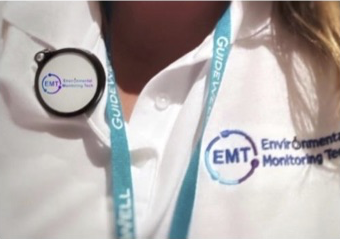
Where do you place the badge?
The badge should be placed on the collar/lapel at breathing zone level. Breathing zone is 10 inches radius of a worker’s nose and mouth.
How much are the badges?
Most badges cost $50.00 each, the BTEX + Saturated Hydrocarbons badge and the Halogenated Anesthetics badge are $55.00, the Full Scan badge is $175.00 (to view the chemicals tests on the Full Scan please visit the Full Scan Badge page.
Does the badge come with instructions?
Yes — every badge comes with instructions (You can preview the instructions here. ) and a monitoring record sheet. Pre-paid return shipping is not included, so you're welcome to use the shipping carrier of your choice to send the badge back for analysis.
How often do I need to be testing?
The laboratory recommends establishing initial exposure monitoring and conducting periodic monitoring as appropriate. Monitoring frequency may vary based on the chemicals used, processes, frequency of use, previous monitoring results, facility circumstances, and applicable regulatory requirements. Monitoring each calendar quarter is one example some facilities choose, depending on their circumstances and monitoring program. Additional testing is needed when procedures or equipment are changed, or when test results are high. When testing in the home, additional testing should be done when there is remodeling, or the addition of new wood products or coatings.
How does the monitoring badge work?
There are no moving parts. The badge weighs less than ounce (28grams). Air diffuses through a micro-porous membrane, and collects on special prepared adsorbents inside the monitoring badge. The accredited lab analyzes the chemicals collected, and reports the average concentration while the device was exposed.
Do you ship internationally?
Yes, shipment by air cargo usually takes only a few days to receive. The badges are nontoxic and do not cause any issues when returning exposed badges to the lab for analysis.
How long should we test for?
Occupational exposure regulations are based on short-term exposure of 15 minutes, and also on a full workday exposure of 8 hours (the badge should be worn at all times including during breaks. The monitoring badge meets OSHA accuracy requirements for a time period from 15 minutes to more than 8-hours.
How many badges do I need to order?
To comply with OSHA requirements, each person who is exposed to the chemical as a regular part of their job should be tested. For indoor air quality, the lab recommends one monitoring badge per approximately 100 square feet. With central heating and cooling, the air recirculation often makes the concentration uniform over a larger area.
Is the analysis included? Is it an accredited laboratory?
Yes the analysis cost is included in the purchase. The analysis is performed by an American Industrial Hygiene Association Laboratory Accreditation Program, LLC (AIHA-LAP, LLC) for industrial hygiene testing, and by The New York State Department of Health (ELAP). The laboratory conforms to ISO Standard 17025. There are strict written quality assurance procedures that are reviewed on site by the accrediting agencies.
How accurate are the results?
For test results to be accepted for laboratory accreditation they must have an overall accuracy better than 25%. The lab’s accuracy is generally in the range of 15% to 20%, varying on the particular chemical, and the exposure time.
How long does it take to get results?
Generally within a week once the lab receives the badge at the lab for analysis. Rush orders can be processed for an additional fee (you must contact us to process the RUSH results request).
How do I receive my results?
Results are returned via email (PDF) in approximately a week after the badge is received at the lab for analysis.
Do I need a blank badge?
A laboratory blank is always used as part of quality assurance at the lab and therefore a blank is not necessary. It should be used when there is a special need to have an unexposed sample with exactly the same history as the exposed field samples.
Is the reported ppm (part per million) based on a TWA (time- weighted average)?
The concentration (ppm or mg/cubic meter) on the laboratory report is the time-weighted average concentration for the actual exposure time that was used. It is not based on an 8 hour period, unless the actual exposure time is 8 hours. There are exceptions to this, when the client requests the results for an 8 hour TWA period, or when it will add to the clarity of the report, as described below. What do ‘Basis 8.00 hours’ or Basis 0.25 hours’ mean? The 8 hour (TWA) time-weighted average and the 15 minute average will be given on the report when these are the actual exposure limits. It will also be given when it adds to the clarity of the report. For example, assume that the permissible exposure limit is 1.0 ppm as an 8 hour TWA, and the result for an actual exposure of 4 hours is 1.4 ppm. The 8 hour TWA will also be given. The reason for this is that 1.4 ppm is above the exposure limit of 1.0 ppm However; the limit is based on 8 hours. The 8 hour TWA shows that the exposure limit is not exceeded, assuming no additional exposure after the actual time of 4 hours. The report will give the actual result for 4 hours (1.4 ppm). It will include “Basis 8 hours 0.7 ppm”.
How does the lab calculate the concentration ppm?
The laboratory measures the milligrams (mg) of each chemical collected during the exposure of the monitoring badge. The collection rate for each chemical (milliliters/minute) is known from actual calibration tests. When the user provides the exposure time (hours or minutes), then it is a simple algebraic calculation to give the concentration in milligrams/cubic meter. The ppm is directly related to the milligrams/cubic meter for each chemical.
Can you help me set up a regular monitoring program at my workplace?
We will be more than happy to set up a cost effective monitoring program to assist you in your OSHA compliance workplace testing. Please call or email us to discuss further details specific to your industry needs.
Do you keep all records; can I get a copy if misplaced?
Yes we keep all records for a minimum of 5 years however it is typically much longer. Please call us or email us to obtain records for misplaced results.
What if the chemical that I need tested is not listed on your website?
Many chemicals have similar structures and properties. They can usually be analyzed. Please contact us with the chemical name and we will consult with lab to see if we can get the badge for that particular chemical.
