 Environmental
 Vapor Monitoring Badge Instructions
EMT chemical vapor monitoring badges can be used for personal exposure monitoring or for room (area) monitoring, depending on the chemical and your monitoring goal.
Sampling requirements vary by chemical and badge type, so always follow any chemical-specific instructions included with your badge.
Procedure
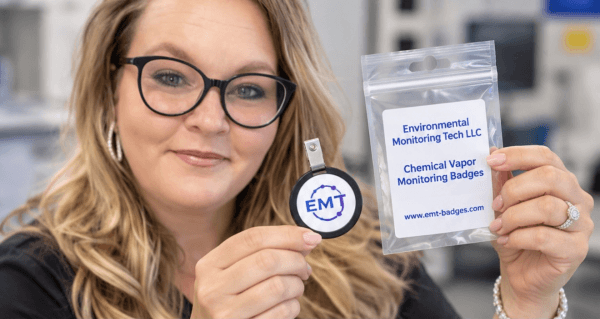
- Prepare your badge. Remove the badge from its package and save the pouch. You will need it to return the exposed badge. On the Report Request Form included with your badge, record the badge number, the chemical being monitored, the employee name or monitoring location, the date, and the start time.
- Position the badge.
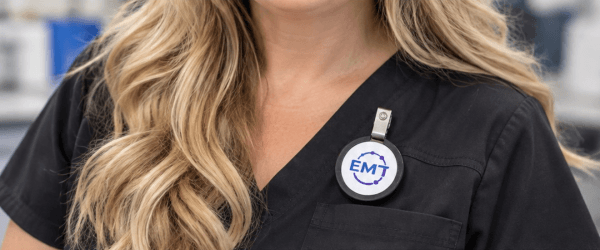
Personal exposure: Clip the badge to the employee’s clothing as shown, near the breathing zone (typically the collar). Do not cover it with clothing. Many OSHA permissible exposure limits are based on an 8-hour time-weighted average, so personal monitoring is typically done over a full 8-hour work shift. Some chemicals also have short-term or ceiling limits that call for different sampling, so follow the recommended duration for your chemical.
Room or area: Place the badge in the area being evaluated, at least 5 feet above the floor. Indoor air monitoring is typically done over 24 hours. Placement and duration depend on the chemical and your monitoring goal, and not every badge is suitable for 24-hour sampling, so follow any chemical-specific instructions included with your badge. An area sample measures the average concentration in the room. It is not the same as an employee’s personal exposure measurement. - Expose the badge. Leave it uncovered in the air to be tested for the full sampling period. For personal monitoring, the badge stays with the employee at all times, even when leaving the area for lunch or breaks.
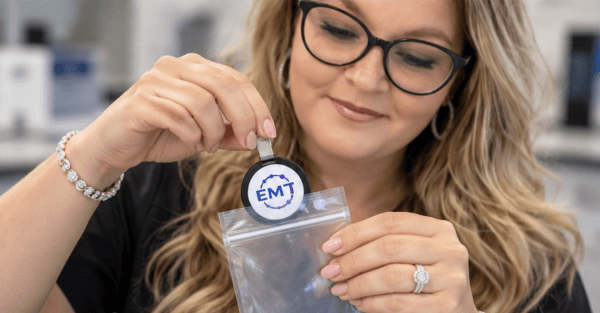
- Record the stop time. Write the stop time on the Report Request Form (and on the pouch if it asks for it). Remove the badge, place it back in its original pouch, and seal it securely. Badges are single use.
- Return the badge. Place the sealed pouch and the completed Report Request Form in a shipping package. You may use the carrier of your choice; FedEx or UPS is recommended. Shipping is not included. For best results, the laboratory recommends returning exposed badges within two weeks of exposure.
c/o Environmental Monitoring Tech LLC (EMT)
821 Waterway Place
Longwood, FL 32750
Laboratory Analysis and Results
Laboratory analysis is included with your badge. Results are typically emailed as a PDF within 7–10 business days after the laboratory receives the exposed badges, excluding weekends and holidays. Turnaround times may vary depending on the chemical, laboratory workload, and any additional analytical requirements.
Expedited (rush) analysis is subject to scheduling, availability, and additional charges. It must be arranged when you ship your badges by calling the laboratory at 561-338-3116.
Analysis is performed by a laboratory accredited by AIHA-LAP, LLC that also holds accreditation through the New York Environmental Laboratory Approval Program (NY ELAP). Accreditation applies to the laboratory’s approved scope of testing.
Understanding Your Monitoring Results
Monitoring results show the airborne chemical concentration during the sampling period. They can help employers and qualified safety professionals evaluate workplace exposure conditions and compare measured concentrations with applicable occupational exposure limits.
Monitoring requirements and frequency depend on the chemicals used, workplace processes, exposure conditions, and applicable regulations. Interpretation of results and workplace exposure assessments remain the responsibility of the employer or a qualified safety professional.
